今天就开始设计,选购最优惠的新年商品



家具前置时间为何成为新的关键路径
Updated 04/03/26
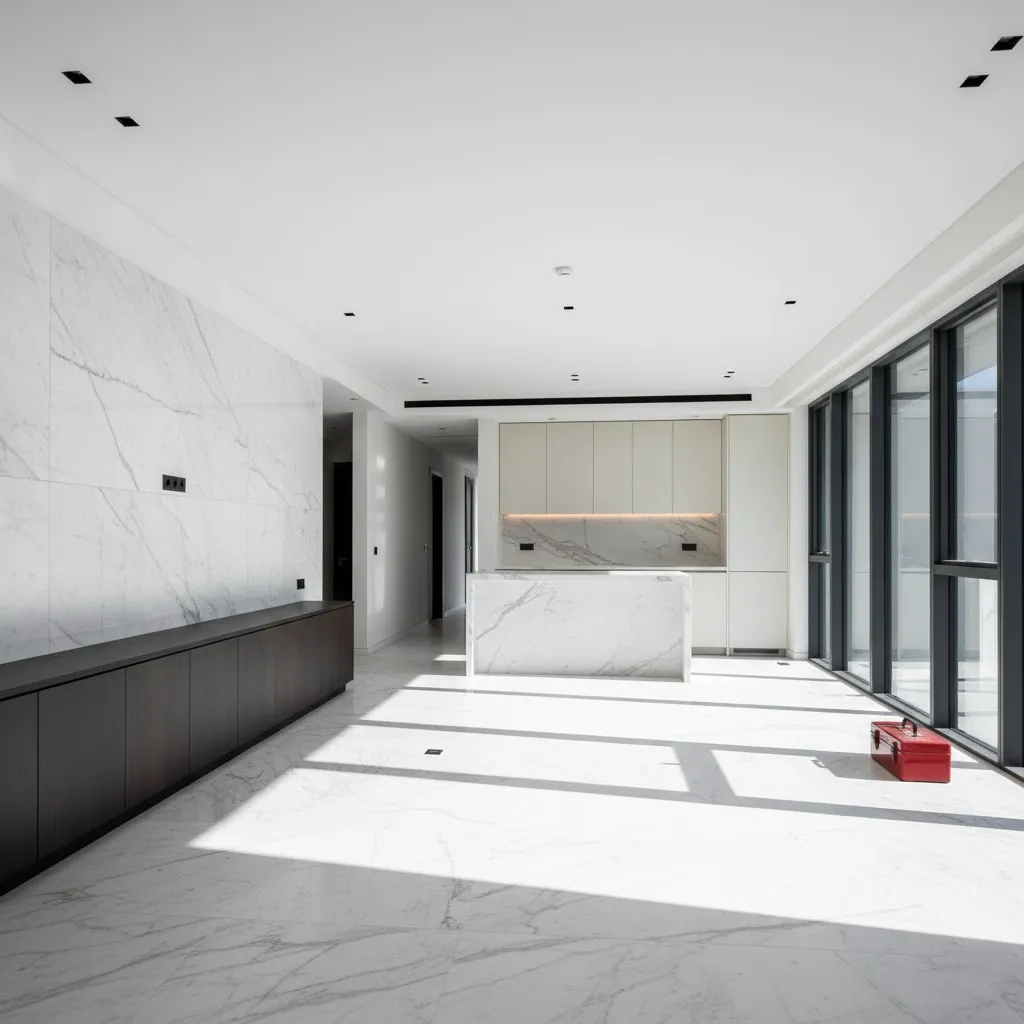
In the landscape of 2026 luxury home renovations, “Substantial Completion” has become a deceptive milestone. We see it far too often: the walls are masterfully painted, the marble is polished to a mirror finish, and the final inspections have passed—yet the homeowners remain in limbo because their rooms are merely echoing voids.
The reality of modern remodeling is that furniture lead times—which encompass specialized manufacturing, international transit, and white-glove installation—are now frequently longer and less predictable than the construction phases they are meant to complement. At George Group, we believe that treating furniture as a final “styling layer” is a strategic error. To achieve a seamless transition from a job site to lived-in luxury, procurement must be treated as a primary schedule driver, integrated into the architectural critical path from day one.
Why Furniture Is the New Scheduling Constraint
Furniture procurement is not a single transaction; it is a complex chain of industrial and artisanal dependencies. The “lead time clock” only begins once specifications are frozen, finishes are approved, and deposits are cleared. It only stops when a piece is placed, leveled, and cleared of its protective packaging.
Between these two points lies a gauntlet of variables: fabrication slots in elite artisanal workshops, the availability of rare raw materials (such as sustainably sourced Grade-A Walnut), rigorous quality control cycles, and global freight logistics. For a whole-house custom project, any fluctuation in this chain can easily consume the “float” typically built into a construction schedule. Furthermore, furniture defines the functional completion of a home. A primary suite may have electricity and climate control, but without a bespoke bed and integrated storage, it remains non-operational. In 2026, the furniture plan is the functional heart of the remodel, not a decorative afterthought.

Decoding Lead Times: Looking Beyond the Surface Numbers
A common pitfall for homeowners is taking a “16-week lead time” at face value. In the high-end sector, that figure usually only represents the time spent on the factory floor. At George Furniture Group, we guide our clients through the “invisible phases” that extend the timeline:
Pre-Production: This includes final on-site measurements, the development of CAD shop drawings for built-ins, and the physical approval of “CFAs” (Cutting for Approval) for custom upholstery.
Post-Production: This involves consolidation at climate-controlled logistics hubs, comprehensive receiving inspections, and the delicate coordination of “Last-Mile” delivery.
Site readiness is the most frequent point of friction. High-end custom woodwork and delicate textiles require stable humidity and dust-controlled environments. Delivering too early risks irreparable damage during the “punch list” phase; delivering too late leaves the client in an uninhabitable house. Management is less about a static number and more about aligning the workshop’s output window with the site’s environmental readiness.
How Long-Lead Items Reshape the Critical Path
In project management terms, furniture enters the Critical Path whenever its installation is a prerequisite for move-in, professional photography, or final occupancy. Even when not technically critical, bespoke items consume the project’s contingency time because high-end craftsmanship is nearly impossible to accelerate without compromising structural integrity.
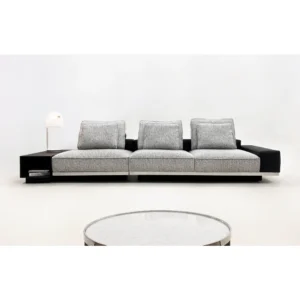
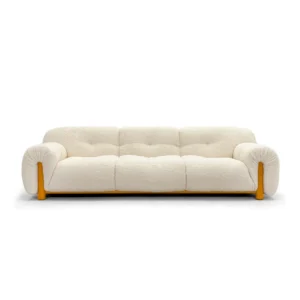
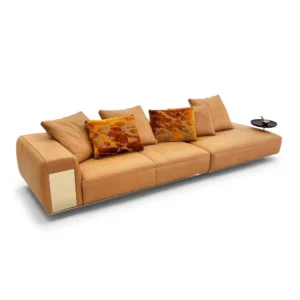
Certain categories are perennial “long-lead” items: custom-modular sectionals, oversized hand-knotted rugs, and artisanal casegoods. When these are selected late, the project team is often forced to rush the final construction finishes to compensate, which invariably leads to aesthetic defects. Our strategy is to identify the “Long-Lead Set” in the first month of design. By locking these specifications early, we allow shorter-lead accessories to remain flexible, providing a buffer for the overall project timeline.
Technical Coordination: The Cost of Missed Connections
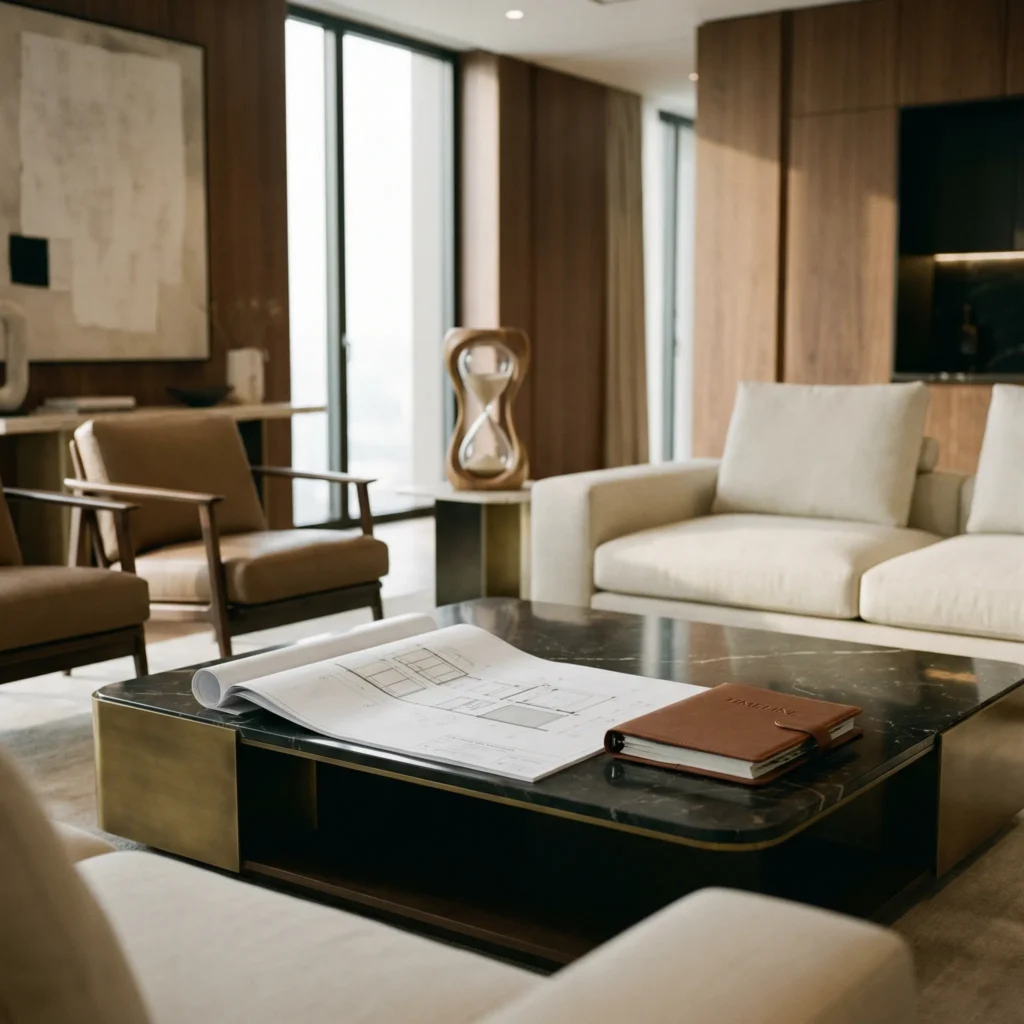
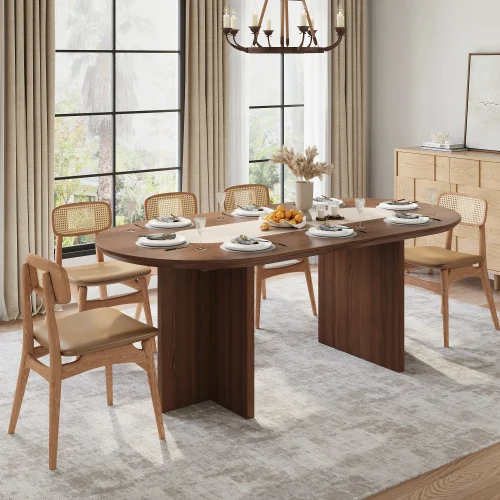
The synergy between furniture and construction goes deeper than aesthetics; it is dimensional and technical. The exact center point of a custom dining table dictates the junction box placement for a five-figure chandelier. The depth of a media console determines the precise layout of recessed outlets and data ports.
If these decisions are deferred, the construction crew is forced to “guess and place,” resulting in misaligned lighting or inaccessible power points. Precision measurement is another high-risk area. Remodel conditions are rarely perfectly square. For fitted furniture, a final site measure must occur after the drywall is up but before the factory slots are missed. A disciplined schedule allows for this “measure-verify-fabricate” loop, preventing the last-minute redesigns that many mistake for “shipping delays.”
Procurement Strategies to Mitigate Risk
A successful remodel requires a Procurement Schedule that runs in parallel with the Construction Schedule. This living document maps every decision deadline, shipping window, and installation milestone.
Our one-stop approach utilizes two key strategies:
Phasing: We prioritize “Core Functional Pieces” (beds, dining, sofas) for the initial delivery wave, allowing the client to occupy the home while secondary accents arrive in a second, non-disruptive phase.
Strategic Substitution: If a specific material faces a sudden global shortage, we provide curated alternatives that preserve the scale, ergonomics, and durability of the original design, ensuring the move-in date remains intact without sacrificing the high-end feel.
The "Hidden" Budget and Logistics Effects
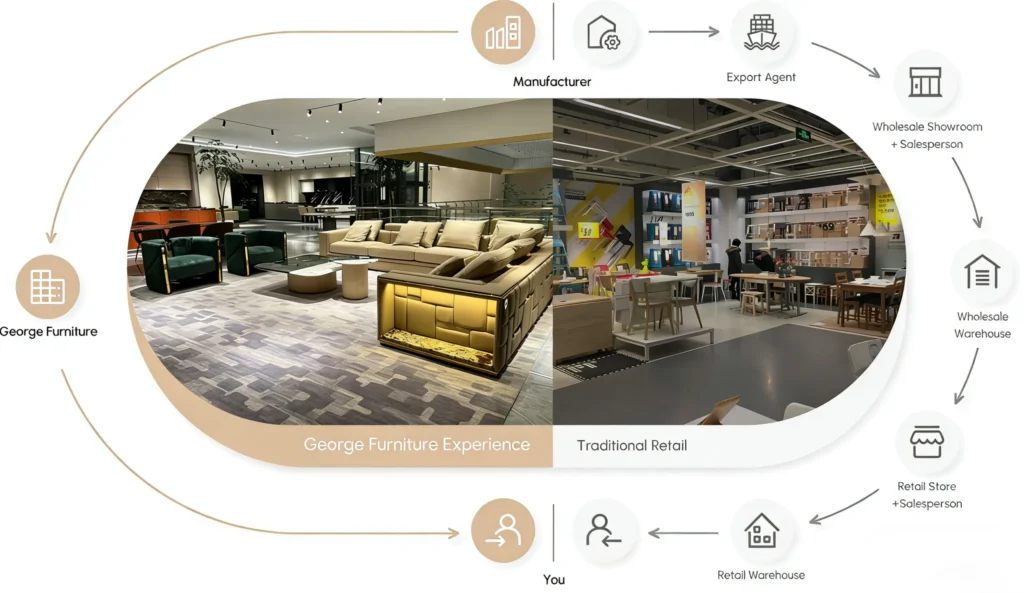
Lead time pressure is often budget pressure in disguise. Attempting to “rush” a custom order 12 weeks into a 20-week cycle leads to exorbitant air-freight fees and premium labor costs. Moreover, logistics require their own specialized schedule.
In 2026, navigating urban building regulations—such as elevator reservations, parking permits for 53-foot freight trucks, and strict floor protection protocols—is a specialized skill. We treat logistics as a core component of the timeline. By reserving delivery appointments months in advance and sequencing the arrival of large-scale items before smaller, vulnerable accessories, we protect both the client’s budget and the integrity of the newly finished site.
A Decision Framework for Seamless Integration
To transform a disruptive surprise into a managed input, we utilize a three-point discipline framework:
The Early Lock: Freeze the layout and major dimensions of “anchor pieces” during the architectural phase to inform utility locations.
Technical Verification: Confirm all mounting requirements and clearance needs before the “rough-in” phase of construction is closed.
The Readiness Sync: Build an installation plan that respects finish cure times (e.g., ensuring floor sealants have fully off-gassed) and site protection protocols.
By categorizing furniture by its impact on construction, we ensure that the transition from “job site” to “home” is a single, celebratory event rather than a fragmented, six-month struggle.
Conclusion: Your Home, Synchronized
Luxury is defined by the absence of friction. At George Furniture Group, our whole-house custom service is designed to bridge the gap between the architect’s blueprint and the final, furnished reality. We don’t just sell furniture; we manage the complex intersection of time, space, and craftsmanship.
您可能还喜欢
Ready to start your own transformation? Partner with George Furniture for a seamless, high-end renovation experience that brings your vision to life.
👉 Explore Our One-Stop Customization Services
在常见问题中了解更多信息
什么是 E0 标准?
"(《世界人权宣言》) E0 标准 是欧洲和国际上对复合木制品甲醛释放量最严格的基准之一。它将甲醛释放量限制在 $\le$ 0.5 毫克/升, 确保卓越的室内空气质量。选择 E0 级材料对于注重环保安全的高端健康家具来说至关重要。.
您能帮我进行家具布局和空间规划吗?
当然可以!我们在家具摆放和空间规划方面的专业知识可确保优化空间内的交通流量、功能性和视觉平衡。.
您能帮我选择油漆的颜色和饰面吗?
绝对!我们的设计师可以提供专业指导,帮助您选择最能与您的空间、风格和现有元素相得益彰的涂料颜色和饰面。.
您能利用现有的家具和装饰吗?
当然!我们可以将现有作品融入设计计划,创造新旧元素的和谐统一,优化功能和视觉效果。.
客户服务。.
美国东部时间周一至周六,上午 9 点至下午 6 点。.
请致电我们。.
+86 18188718632
地址
禅城区季华四路卡萨陶瓷洁具市场24栋 中国广东省佛山市禅城区季华四路 中国广东省佛山市



产品比较
| 说明 |
| 价格 |
| 供应商 |
| 类型 |
| 产品变体 |
- 选择一个选项会刷新整个页面。.
- 在新窗口中打开。.
已添加到购物车